
Lina Maria Espinosa
Lina María Espinosa Villegas is a human rights defender, holding a Master’s degree in strategic litigation, a degree in social sciences and anthropology, and a law degree. The central focus of her human rights work is the defence of collective rights and the rights of nature. She is currently a member of Amazon Frontlines and co-founder of the Alliance of Human Rights Organisations of Ecuador. For over a decade, she has supported the struggles of indigenous peoples and nationalities in Ecuador, Colombia and Peru who are resisting the dispossession of their territories, extractive projects, the presence of irregular armed groups, and the violation of their territorial and collective rights. She has also provided support and legal representation to individuals and communities who have been victims of serious human rights violations. Her work combines strategic litigation, technical support in the field and the training of community leaders, with a focus on the self-determination of indigenous peoples and the rights of nature.
Lina María Espinosa Villegas has played a key role in supporting various indigenous communities and organisations. In her work with the Siona people, a cross-border community between Ecuador and Colombia, she was part of the team that promoted the request for precautionary measures before the Inter-American Commission on Human Rights ( IACHR) on behalf of the Po Piyuya and Gonzaya reserves in Putumayo, in response to the risk of physical and cultural extermination arising from the armed conflict and the lack of state protection. In this context, her work has been crucial in highlighting the urgent need for international protection and strengthening community strategies to defend their territory.
Lina María Espinosa Villegas has promoted processes to enforce the right to self-determination and to free, prior and informed consent for indigenous peoples and nationalities in Ecuador, including the cases of the A’i Cofán community of Sinangoe against unconsulted mining concessions on the Aguarico River and the Waorani communities of Pastaza against oil tenders based on prior consultations conducted in bad faith. Her work has contributed to landmark rulings by the Ecuadorian Constitutional Court that reinforced standards on consultation and consent, and recognised indigenous guards as legitimate forms of organisation and exercise of authority by indigenous peoples. In these processes, she has supported the strengthening of Cuiracua, the Siona (Ziobain) guard, Kuirasundekhu A´i Cofán of Sinangoe, Wajosar´a Siekopai, Tayak Runakuna of Pakkiru, and Nee Wanonani Meñebai of the Waorani of Pastaza, amongst others, in the exercise of their rights and in their role of territorial governance and protection against external threats.
Due to her defence of human rights, Lina María Espinosa Villegas has been subjected to threats, stigmatisation and criminalisation by both state and private actors. She has faced criminal charges for her work supporting communities in their efforts to assert their rights in relation to oil spills and mining concessions, as well as disciplinary investigations aimed at intimidating her and undermining the legitimacy of her legal and political work. The Human Rights Alliance has documented death threats and surveillance against her, the IACHR has granted her precautionary measures, and Colombia’s National Protection Unit has recognised an extraordinary level of risk to her life and physical integrity, as well as that of her family.
In addition to her work in litigation and accompaniment in the field,, Lina María Espinosa Villegas has participated in dialogue forums between the national government and the indigenous movement in Ecuador, and also at the roundtables established following the protests of 2019 and 2022, where she provided technical and legal support. This role has also exposed her to further accusations and the opening of criminal investigations, in a context of growing hostility towards those who defend the rights of indigenous peoples and nature. Despite these risks, she continues her work as a human rights defender, maintaining that legal support, the strengthening of indigenous guards and regional coordination are essential tools for safeguarding lives, territories and collective rights in the Amazon.
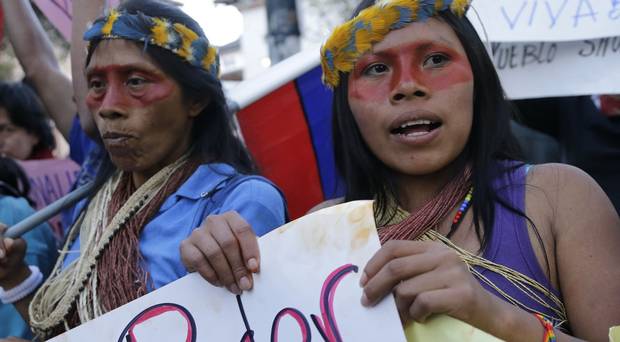
While the new Constitution promulgated in 2008 contained clauses referring to the environment and its protection, over the last couple of years, the government has permitted multinational corporations to enter and exploit oil and gas reserves to the detriment and devastation of the environment and indigenous communities. HRDs working to protect the environment increasingly find themselves targeted and in need of protection.

